
Visualisations and the Digital Memory Database

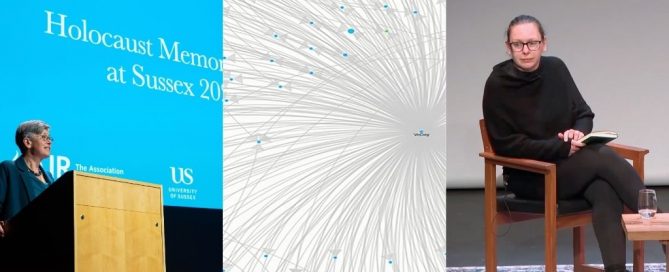
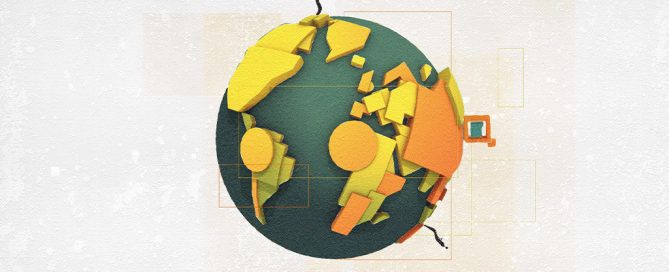
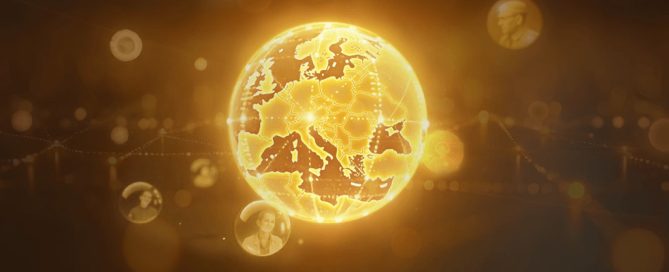
By Dr. Ben Pelling In this week’s blog, Research Fellow Dr, Ben Pelling introduces the data visualisations embedded into the Digital Memory Database – our flagship platform, launching later this month. In building the Digital Memory Database, to be publicly launched on International Day of Commemoration in Memory of the Victims of the Holocaust, we have included a number of interactive visualisations that use a live feed of the data contained within the database and so adjust and update as new content is added. These visualisations have two purposes – they offer alternative ways to explore the projects, interviews and walkthroughs but also form the foundation for quantitative analysis of the data and metadata captured in the database as a whole. Each has been deliberately designed to provide filtering and sorting options, so that each user can focus on the information they seek. World View (Globe/Map) Central to the homepage is a map, viewable in either globe or ‘flat’ map form, that locates all  the organisations that have been included in the database. Although the database can be interrogated via the search function and browsed via the archive index, the map provides a visual way to explore the content. [...]
By |2026-01-15T12:50:32+00:0015 January 2026|

Digital data spaces: the future of European Holocaust data?

What is a data space and what are the preconceptions around them? Our Lab Director interviews Pavel Kats, Coordinator of the European Memory Data Space Blueprint project and discovers why the data space movement is at a critical point and crucially, why Europe needs a data ecosystem dedicated to Holocaust memory. Victoria Grace Richardson-Walden: What is a 'European Data Space'?  Pavel Kats: Common European Data Spaces (https://digital-strategy.ec.europa.eu/en/policies/data-spaces) are a bold innovation attempt by the European Commission to fundamentally rethink how we share and use data. They’re being funded and launched in many fields, from business sectors like industry and transport to societal domains like cultural heritage, to help individuals, businesses and institutions address the main digital challenge of our times: the growth of data and our inability to efficiently put it to use. For data to bring value, it must be used: in different ways and by different tools; across borders, stacks and institutions; and by different audiences. Yet, traditional data architectures are not built for that. In cultural heritage, we see it better than anywhere else. Every aggregation platform, whether national, European or thematic, at the same time exposes, suffers from and often exacerbates the same set of [...]

By |2025-11-06T09:15:22+00:006 November 2025|

New Sites of Memory Making: Augmented Reality and Holocaust Memory

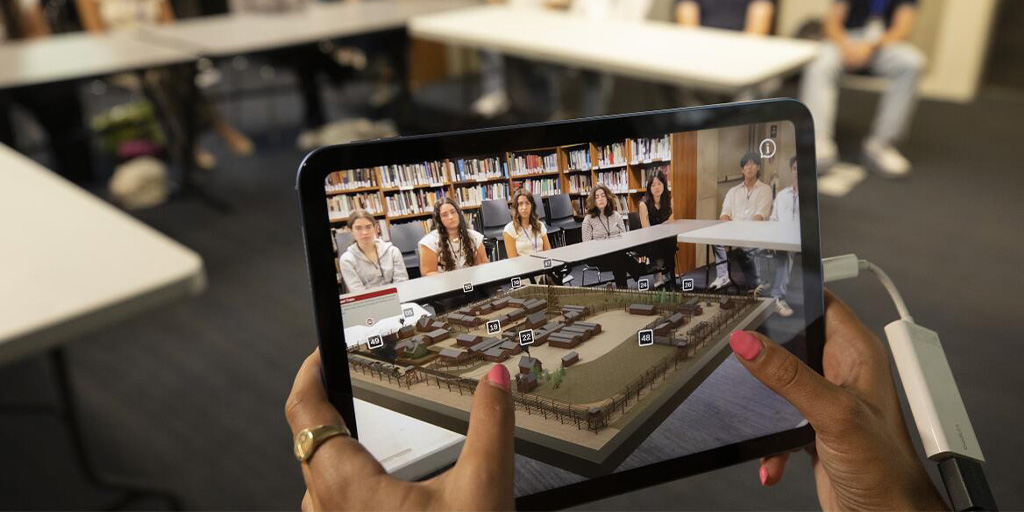
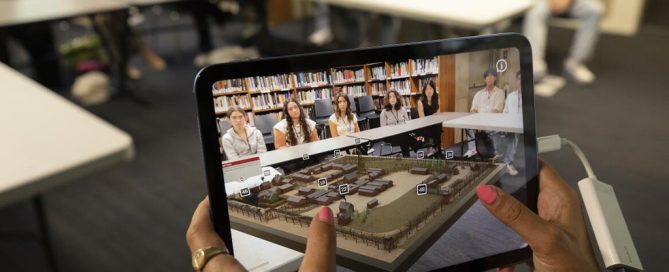
By Prof. Victoria Grace Richardson-Walden Augmented Reality or ‘AR’ is still an emerging field in Holocaust memory. We explore examples from AR practice and theory and propose five recommendations for its future development. What do we mean when we talk about ‘augmented reality’ or ‘AR’ projects? Blancas et al. (2021) bring together several definitions which emphasise that AR does not refer to a singular medium or technology: Augmented Reality (AR) enriches the physical world with digital information, annotating reality and supplementing it with additional information (Feiner et al., 1997). A classical definition considers it a form of Mixed Reality (XR) in which a real-world view is supplemented by synthetic sensory input (Milgram & Kishino, 1994). For some authors, AR should fulfil at least three properties: combining real and virtual, interactive in real time, and registered in three dimensions (Azuma, 1997). An ideal AR system would make users believe the virtual and real objects coexist in the same space, blurring the frontier between real and virtual (Billinghurst et al., 2002). It might be best then to define augmented reality as: a particular mode of mediation, which produces a specific relationship between the body and the lived-world with and through media. [...]

By |2025-10-30T10:32:10+00:0030 October 2025|

Do Media Literacies Have a Place in Holocaust Education?

By Victoria Grace Richardson-Walden Recent opportunities to engage with Holocaust education experts through the Lab have left us contemplating the role of media literacies.  Lab Director Prof. Victoria Grace Richardson-Walden explains why a change is needed and presents her ideas for forging a new path in this field. Research demonstrates that we both ask too much of Holocaust education and do not have a coherent definition of it is a ‘subject’ or ‘field’, and yet we treat it as if it is distinct from other school disciplines. It is both a space for learning about the specific past that has been called ‘the Holocaust’ and laden with additional moral responsibilities unlike any other historical topic. In this respect it is also considered to be a subject which we must learn from to become better citizens, to enhance our ethical compass. The aims presented in the previous version of the International Holocaust Remembrance Alliance’s Recommendations for Teaching and Learning about the Holocaust (2019) make this clear: learn knowledge about the history preserve memory of the victims encourage and empower students to reflect on contemporary relevance. Many surveys have suggested that knowledge about the Holocaust is weak (https://www.claimscon.org/millennial-study/, https://www.claimscon.org/country-survey/, https://www.ucl.ac.uk/ioe/news/2021/nov/survey-exposes-lack-knowledge-about-holocaust), and [...]

By |2025-10-23T10:02:03+01:0023 October 2025|

Reflections from the Memory Studies Association Conference, Prague

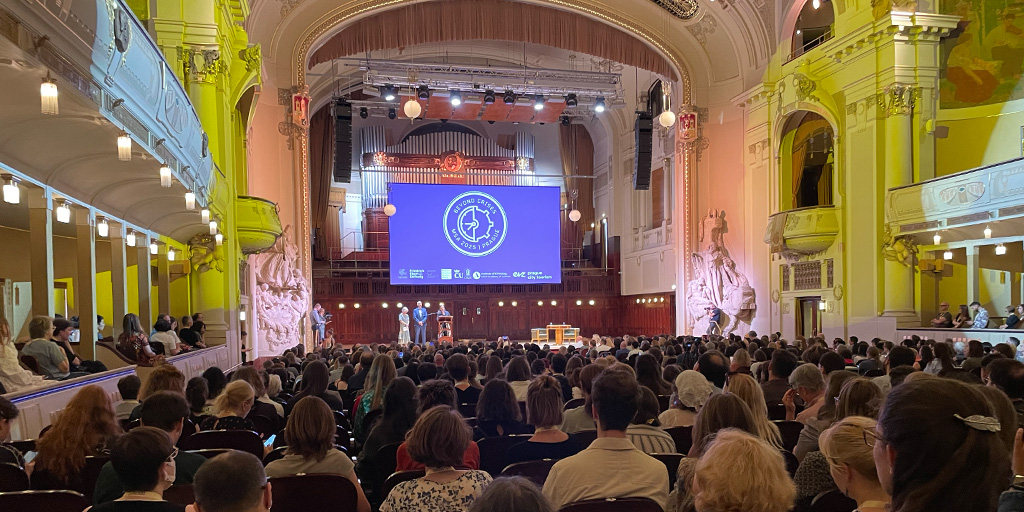
The research team of the Landecker Digital Memory Lab recently attended the Memory Studies Association’s annual conference, the world-leading event in the field, this year held across Charles University and the Czech Academy of Sciences in Prague, Czechia. During the packed, five-day programme, the Lab contributed to five sessions and joined many others. Find out what we shared and learned from three distinct perspectives. By Dr. Ben Pelling, Dr. Kate Marrison and Prof. Victoria Grace Richardson-Walden Dr. Ben Pelling, Research Fellow, Landecker Digital Memory Lab: As someone new to memory studies, the size of MSA Prague was at first quite overwhelming, with more than 1,400 participants. However, this does mean that there are plenty of panel sessions, workshops, tours and other events to suit all areas of scholarship or mere curiosity. There was ample opportunity to sample sessions on topics diverse from one’s own research focus - a great way to learn about new methods and approaches that can be adopted and co-opted as needed or just enjoy the work of scholars studying a completely different topic. One thing I learned during the event was that memory scholars are starting to engage with online, digital and mapping resources in their [...]

By |2025-09-25T13:23:36+01:0025 September 2025|

Behind the Scenes at the Lab: What’s in the Works?

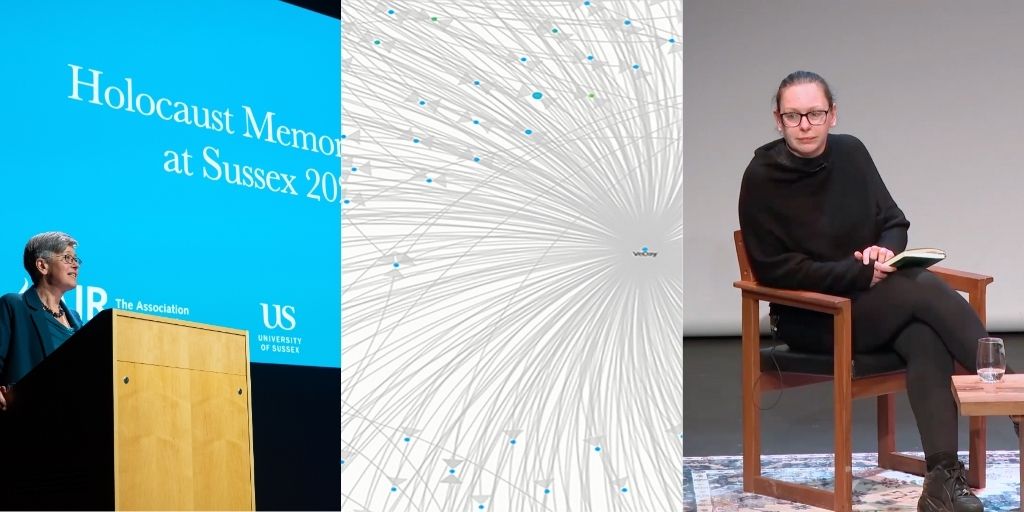
It’s been an extremely busy start to the year at the Lab. Find out what we’ve been up to behind the scenes as we approach an exciting new phase of our programme. We kicked off 2025 by welcoming a new member of the team. Research Fellow Dr Ben Pelling has an academic background in History and his previous postdoctoral role focused on the impact of digitisation on conspiracy theories across Europe. Last month, he presented some work in progress related to our living database archive at the Sussex Digital Humanities Lab's Research Forum alongside some fascinating projects, including one about AI in music. Welcome Ben. We are very happy that you have joined the team. Holocaust Memorial Day Early February saw an excellent Holocaust Memorial Day programme hosted by University of Sussex, the first university in England to commemorate this annual event. Our Director Professor Victoria Grace Richardson-Walden took part in a discussion and Q&A with founder and president of the UK Jewish Film Festival Judy Ironside MBE focused on the screening of Letter to a Pig. The short film is an Oscar-nominated animation Letter to a Pig (watch the 'making of'), which explores a young girl's dream after listening to [...]

By |2025-08-01T09:59:04+01:0013 March 2025|
Go to Top