
Digital Holocaust Memory – Resources and Readings

Over the summer, the Landecker Digital Memory Lab team members are busy taking well-deserved breaks. Whilst our blog goes on hiatus, here are some suggested reads from our back catalogue which might help inspire or inform your autumn teaching, research and practice. The remit of the Landecker Digital Memory Lab is broad – we conceptualise ‘the digital’ as socio-technical and thus connective, and as an entanglement of human and computational actancies. But what does this mean in practice? Firstly, it means our research covers a range of different digital media, this includes computer games. Last year we hosted an international junior research associate, Austin Xie, from the University of Chicago who thought through the challenges of navigating Holocaust memory in computer games shared in two blogs on our site, part I and part II. We also launched recommendations for using VR, XR and computer games. We captured more on these topics in our blog archive, check out pieces on Playing Memories,  Reading Call of Duty, and student ideas for Holocaust computer games. The first series of our new Digital Memory Dialogues also focuses on this topic asking to what extent can the Holocaust be made playable in computer games? This [...]

By |2025-08-28T13:23:52+01:0014 August 2025|

2024: A Year in Review

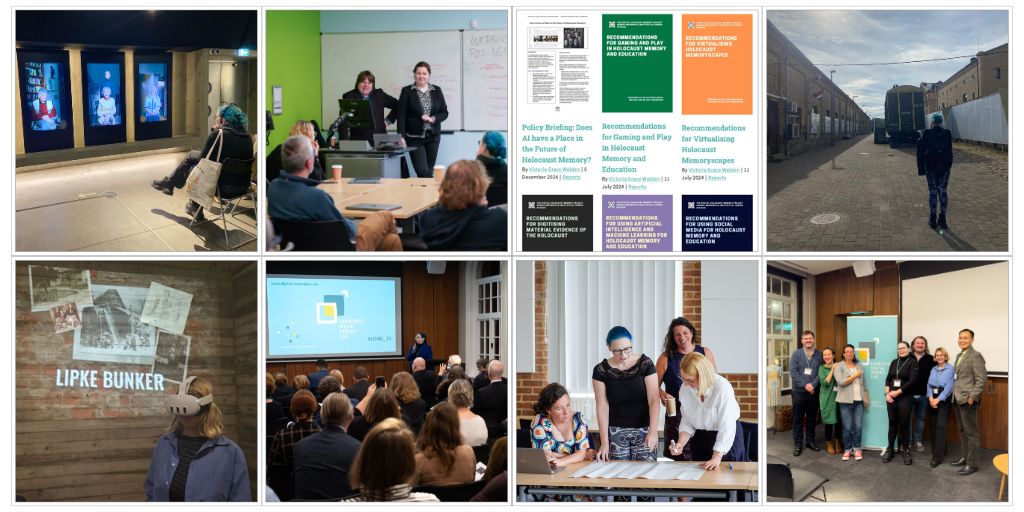
By Prof. Victoria Grace Richardson-Walden The year 2024 will be unforgettable to us, as the year we launched the Landecker Digital Memory Lab. We look back at what we’ve achieved. It was at a public lecture held at the Melbourne Holocaust Museum in April that we were finally able to announce the Landecker Digital Memory Lab was coming into existence. Since then, we’ve been non-stop! My two-week residential at the museum also included co-hosting a symposium on ‘Preserving Truth in the Digital Age’ and led to us confirming the Melbourne Holocaust Museum as an official project partner. We’re looking forward to collaborating with them further. Read our ‘Spotlight’ piece on the museum to find out more about their digital work past and present. The Melbourne trip was followed in September by further fieldwork in Riga, Latvia at the Žanis Lipke Memorial where we explored their use of VR. Engagement with intergovernmental organisations, policymakers and funders was a dominant thread of our first few months, particularly with the hype about ‘AI’. In June, we hosted the workshop ‘Policy and Funding Sustainable Interventions in Digital Holocaust Memory and Education’ together with the Holocaust and the United Nations Outreach Programme. The event was attended by [...]

By |2025-01-13T09:27:29+00:008 January 2025|
Go to Top